Melasma, the stubborn brown patches that appear on the cheeks, forehead and upper lip, is one of the most common reasons people see a dermatologist about their skin. For decades, hydroquinone 4% has been the treatment every new product is measured against. In 2026, new head-to-head studies are testing that position. Here is what they show, how hydroquinone works, and how to use it safely.
What is melasma?
Melasma is a chronic pigment disorder that mainly affects women aged 20 to 40, especially people with medium to darker skin tones. Sunlight, visible light, hormones (pregnancy, birth control pills) and genetics all play a part. It tends to come back, so treatment usually means getting it under control and then maintaining results.
How hydroquinone works
Hydroquinone blocks tyrosinase, the enzyme that skin cells use to make melanin. Less melanin means the dark patches gradually fade. Most people start to see lightening after 4 to 8 weeks of nightly use, with fuller results at around 12 weeks.
- 2% hydroquinone: a milder strength, used for light pigmentation or sensitive skin.
- 4% hydroquinone: the standard prescription strength for melasma.
- Triple-combination cream: hydroquinone 4% plus tretinoin 0.05% (speeds up skin turnover) and fluocinolone acetonide 0.01% (a mild steroid that calms irritation). This formula, sold as Tri-Luma, is FDA-approved for moderate to severe facial melasma for up to 8 weeks of use.
Rules differ by country. In the United States, hydroquinone has been prescription-only since the 2020 CARES Act removed over-the-counter skin-lightening products. In the European Union it is not allowed in cosmetics and is available only as a medicine.
What the 2026 research shows
Malassezin vs. hydroquinone 4%
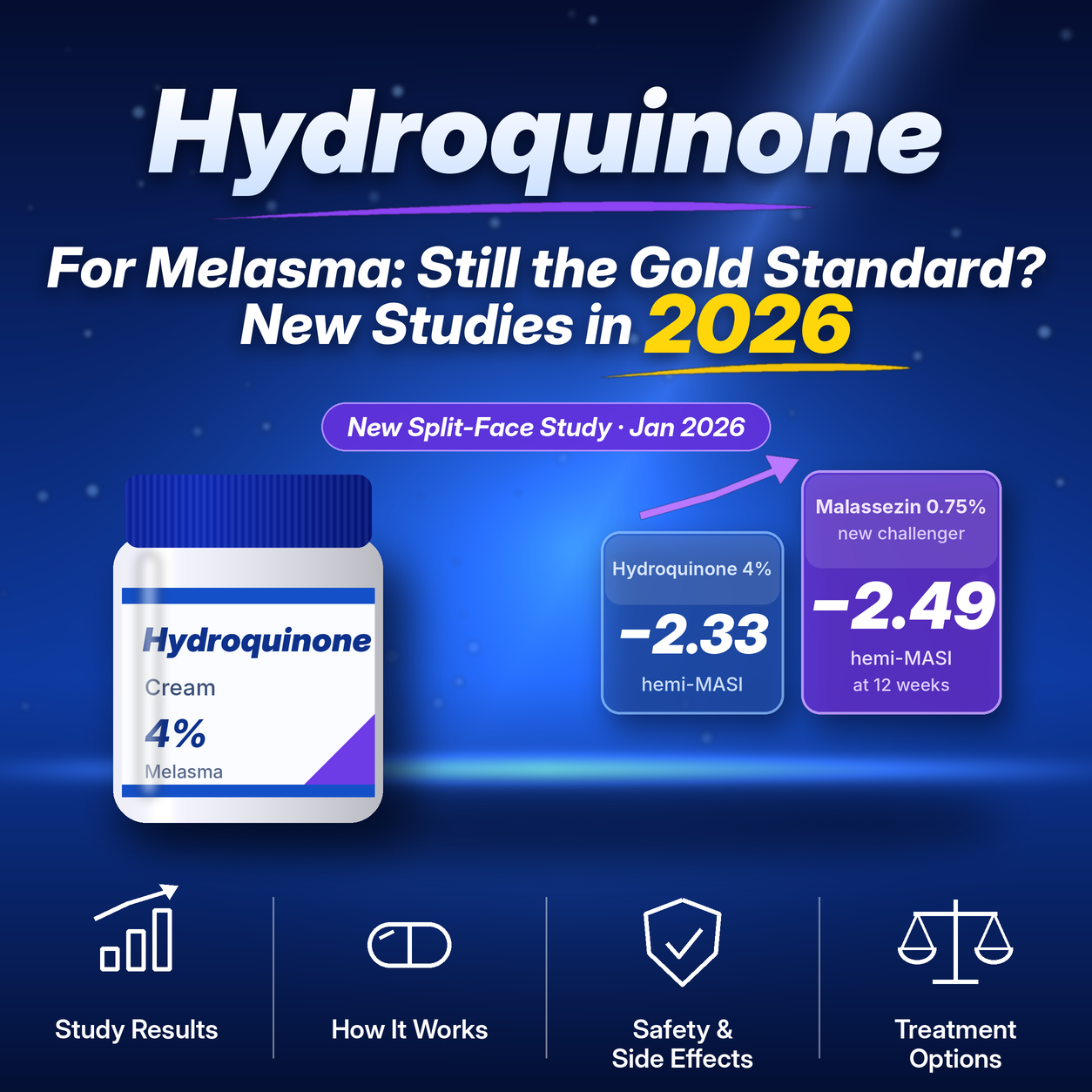
In January 2026, the Journal of Drugs in Dermatology published a randomized, double-blind, split-face study led by dermatologist Pearl Grimes. Twenty women with mild to moderate melasma applied 0.75% malassezin to one side of the face and hydroquinone 4% to the other, twice daily for 12 weeks.
| 12-week result | Malassezin 0.75% | Hydroquinone 4% |
|---|---|---|
| Reduction in hemi-MASI score | 2.49 | 2.33 |
| Significant vs. baseline | Yes (P<0.001) | Yes (P<0.001) |
| Difference between sides | Not statistically significant | |
Side effects on both sides were mild. The authors concluded that malassezin was comparable to the gold standard. The study was small, though, and malassezin is not yet a widely available medicine.
Other challengers
- 2-mercaptonicotinoyl glycine (Mela B3): a 2025 trial in 109 women found this serum non-inferior to hydroquinone 4% over 3 months, with better tolerability.
- New combination creams: an early-stage trial that started in May 2026 is testing hydroquinone 4% plus tretinoin 0.025% against hydroquinone alone.
The pattern is clear: newer ingredients are being judged by whether they can match hydroquinone. So far, some can come close with fewer side effects, but hydroquinone and triple-combination creams remain the reference treatments that dermatologists reach for first in moderate to severe melasma.
How to use hydroquinone safely
- Patch test first. Apply a small amount behind the ear or on the inner arm for 24 hours.
- Apply a thin layer at night only to the dark patches, avoiding the eyes and lips.
- Use sunscreen every day. A broad-spectrum SPF 50, ideally tinted (iron oxides block visible light), is essential. Without it, melasma returns quickly.
- Use it in cycles. Many dermatologists recommend 3 to 4 months of use followed by a break, switching to a non-hydroquinone product for maintenance. Triple-combination creams are usually limited to 8 weeks at a time.
- Stop and see a doctor if the skin darkens, turns blue-black, or becomes very irritated.
Possible side effects
- Redness, dryness, stinging or peeling, especially with tretinoin combinations
- A temporary halo of lighter skin around treated patches
- Rarely, exogenous ochronosis, a blue-black darkening linked to long-term, high-strength or unsupervised use
Avoid tretinoin-containing creams during pregnancy, and ask a doctor before using any lightening product while pregnant or breastfeeding.
Melasma treatments at Zarvypharm
- Hydroquinone creams: Eldoquin 2% and Eldoquin Forte 4%.
- Triple-combination creams: Triluma, Triglow, Melacare Forte and Eukroma Plus (hydroquinone + tretinoin + a mild steroid).
- Maintenance and non-hydroquinone options: azelaic acid (Skinoren 20%, Finacea 15%), kojic acid creams (Kojiglo Forte, Demelan) and tretinoin gels (A-Ret 0.025%–0.1%).
Acne marks and melasma can look similar but need different treatment. For acne itself, see our guide Isotretinoin for Acne: Why It Works When Others Fail.
FAQ
How long does hydroquinone take to work?
Most people notice lightening after 4 to 8 weeks, with the best results at about 12 weeks of consistent nightly use plus daily sunscreen.
Is hydroquinone safe?
Used correctly, for limited periods and with medical guidance, it is considered safe and effective. The main risks come from long-term continuous use, very high strengths or unregulated products.
Can melasma be cured?
Melasma can be controlled, but it often returns with sun exposure or hormonal changes. Daily sun protection and a maintenance plan are the keys to lasting results.
Which is better: hydroquinone alone or a triple cream?
Triple-combination creams generally work faster for moderate to severe melasma but cause more irritation. Hydroquinone alone may suit milder cases or sensitive skin.
The takeaway
New 2026 studies show that some alternatives can match hydroquinone 4% in small trials, which is promising for people who cannot tolerate it. For now, hydroquinone and triple-combination creams remain the benchmark for melasma, as long as they are used in cycles and paired with strict daily sun protection.
Disclaimer: This article is for informational purposes only and does not replace advice from a qualified healthcare professional. Hydroquinone and tretinoin are prescription medicines in many countries. Always consult a doctor or dermatologist before starting, stopping or changing any treatment.
References
- Grimes PE, Dias S, Oparaugo NC, et al. A randomized, controlled, split-face, double-blind study comparing topical malassezin to hydroquinone 4% for melasma. J Drugs Dermatol. 2026;25(1):25.
- Efficacy and tolerability of a new facial 2-mercaptonicotinoyl glycine-containing depigmenting serum versus hydroquinone 4% over 3-month treatment of facial melasma. 2025 (PubMed 40586974).
- Tri-Luma (fluocinolone acetonide 0.01%, hydroquinone 4%, tretinoin 0.05%) cream. US prescribing information.
- Balado-Simó P, et al. An updated review of topical tretinoin in dermatology. J Clin Med. 2025;14(22):7958.