November 9, 2026 | Zarvypharm Health News
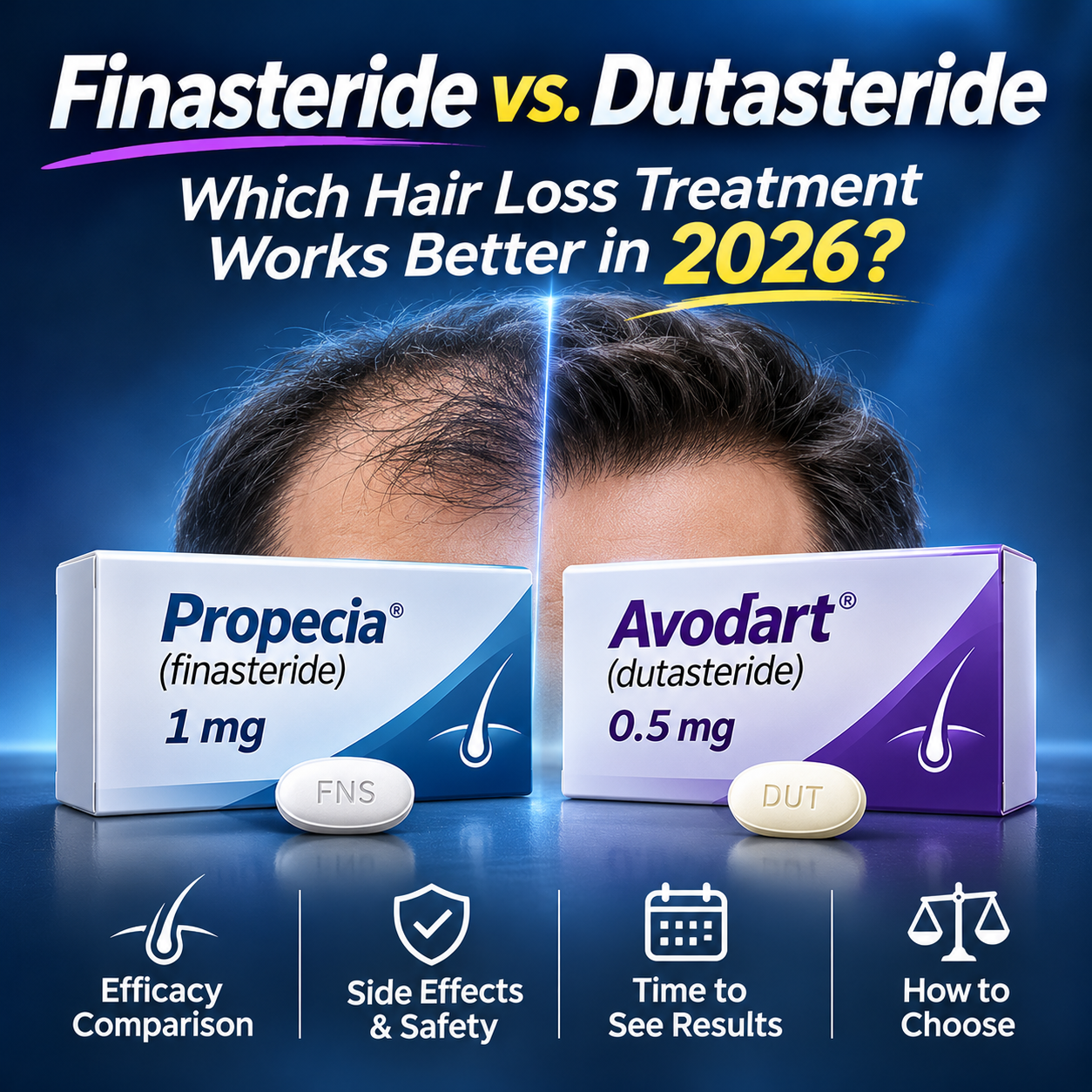
Finasteride and dutasteride are two established medications for male pattern hair loss. Recent research suggests that dutasteride may offer stronger average hair regrowth, while updated safety warnings highlight the importance of choosing treatment carefully.
How Do Finasteride and Dutasteride Work?
Male pattern hair loss, also called androgenetic alopecia, is strongly influenced by dihydrotestosterone (DHT), a hormone derived from testosterone.
In genetically susceptible individuals, DHT contributes to the gradual miniaturization of scalp hair follicles.
Both finasteride and dutasteride inhibit 5-alpha-reductase, the enzyme responsible for converting testosterone into DHT.
However, their mechanisms differ:
-
Finasteride primarily inhibits type II 5-alpha-reductase.
-
Dutasteride inhibits both type I and type II 5-alpha-reductase.
This broader enzyme inhibition generally produces greater suppression of circulating DHT with dutasteride.
Which Medication Is More Effective?
A 2025 network meta-analysis of 33 studies found that oral dutasteride 0.5 mg daily ranked highest among the evaluated monotherapies for male pattern hair loss.
An earlier analysis published in JAMA Dermatology also favored dutasteride 0.5 mg over finasteride 1 mg for hair-count improvement.
However, not every study has demonstrated a significant difference.
A randomized clinical trial published in July 2026 compared finasteride 1 mg with dutasteride 0.5 mg in 46 men over 24 weeks. Both groups improved in hair density and thickness, without a statistically significant difference between treatments.
The overall evidence therefore favors dutasteride for average efficacy, but individual results vary and smaller studies may not detect differences reliably.
Finasteride vs. Dutasteride: Key Differences
| Feature | Finasteride | Dutasteride |
|---|---|---|
| Common oral hair-loss dose | 1 mg daily | 0.5 mg daily |
| Enzyme inhibition | Mainly type II | Types I and II |
| Average efficacy in comparative research | Effective | Often greater |
| Original brands | Propecia | Avodart |
| US FDA approval for hair loss | Yes, 1 mg | No |
| Hair-loss approval in South Korea and Japan | Yes | Yes |
| Approximate terminal half-life | 5–6 hours | About 5 weeks |
Dutasteride's longer half-life means that it remains in the body considerably longer after discontinuation.
Approval status varies by country. In the United States, Avodart is approved for benign prostatic hyperplasia, not androgenetic alopecia.
How Long Does It Take to See Results?
Finasteride generally requires at least three months of consistent treatment before benefits become apparent.
Visible changes in hair density often take six months or longer.
Dutasteride also requires sustained treatment, and clinical studies commonly assess outcomes over 24 weeks or more.
Both medicines primarily aim to slow further hair loss and improve or maintain existing hair coverage.
Neither guarantees complete restoration of hair in advanced bald areas.
Stopping treatment may gradually reverse the benefits.
What About Side Effects?
Both medicines can cause decreased libido, erectile dysfunction and ejaculation-related problems.
A systematic review published in 2026 reported sexual adverse-event rates of approximately 1.9–6.7% with oral finasteride 1 mg and 4.1–12.0% with dutasteride 0.5 mg across the included trials.
These ranges come from different studies and should not be treated as a direct comparison of risk.
In May 2026, the UK's Medicines and Healthcare products Regulatory Agency strengthened warnings concerning psychiatric symptoms and sexual dysfunction associated with finasteride and added precautionary information for dutasteride.
Depression and suicidal thoughts require prompt medical attention. UK guidance advises stopping finasteride 1 mg and contacting a doctor promptly if depression or suicidal thoughts develop.
Both medicines are contraindicated during pregnancy because of the potential risk to a developing male fetus.
Original Brands vs. Generic Medicines
Propecia is the original branded finasteride 1 mg product for male pattern hair loss.
Avodart is the original branded dutasteride 0.5 mg product.
Approved generic medicines contain the same active ingredient and strength as their reference products and must meet applicable quality and bioequivalence requirements.
A generic finasteride product is not equivalent to dutasteride simply because both belong to the same drug class.
Patients should compare the active ingredient, dose, dosage form, manufacturer and local regulatory approval rather than relying on the brand name alone.
Which Treatment Should Patients Choose?
Finasteride 1 mg remains an established option with extensive clinical experience and US FDA approval for male pattern hair loss.
Dutasteride 0.5 mg may be considered where it is approved for hair loss or where a clinician determines that off-label treatment is appropriate.
Its stronger average efficacy in comparative research may be relevant for patients with progressive hair loss, but it also has a substantially longer half-life.
Treatment choice should account for hair-loss severity, previous response, reproductive considerations, medical history and tolerance of potential adverse effects.
Frequently Asked Questions
Is dutasteride stronger than finasteride?
It generally suppresses DHT more extensively, and comparative research often finds greater average hair regrowth.
Can finasteride and dutasteride be taken together?
Routine combination use is not an established standard treatment and should not be attempted without specialist assessment.
Is dutasteride FDA-approved for hair loss?
No. Its US approval is for benign prostatic hyperplasia. Hair-loss approval exists in certain other countries, including South Korea and Japan.
Are generic products less effective than original brands?
An appropriately approved bioequivalent generic is expected to provide comparable exposure to the same active ingredient. Quality and approval status are essential.
Final Thoughts
Finasteride and dutasteride remain important oral treatments for androgenetic alopecia.
Current comparative evidence generally favors dutasteride 0.5 mg for average hair-count improvement, while finasteride 1 mg remains a widely established first-line option.
The best choice is not necessarily the medicine with the strongest DHT suppression. It is the treatment that offers an appropriate balance of effectiveness, safety and long-term suitability for the individual.
This article is intended for pharmaceutical education. Prescription treatment should follow applicable local approvals and clinical assessment.
References
-
Comparative Efficacy of Minoxidil and 5-Alpha Reductase Inhibitors Monotherapy for Male Pattern Hair Loss, 2025.
https://pmc.ncbi.nlm.nih.gov/articles/PMC12207719/ -
Efficacy and Safety of Oral Finasteride Versus Dutasteride, published July 2026.
https://doi.org/10.1080/09546634.2025.2583849 -
UK MHRA, Finasteride and Dutasteride: Updated Safety Warnings, May 11, 2026.
https://www.gov.uk/drug-safety-update/finasteride-and-dutasteride-updated-safety-warnings-for-psychiatric-side-effects-and-sexual-dysfunction -
US FDA — Propecia prescribing information.
https://www.accessdata.fda.gov/drugsatfda_docs/label/2021/020788s028lbl.pdf -
US DailyMed — Avodart prescribing information.
https://www.dailymed.nlm.nih.gov/dailymed/fda/fdaDrugXsl.cfm?setid=813507ec-1fc1-420f-ac5c-5c794b1059cd&type=display