November 16, 2026 | Zarvypharm Health News
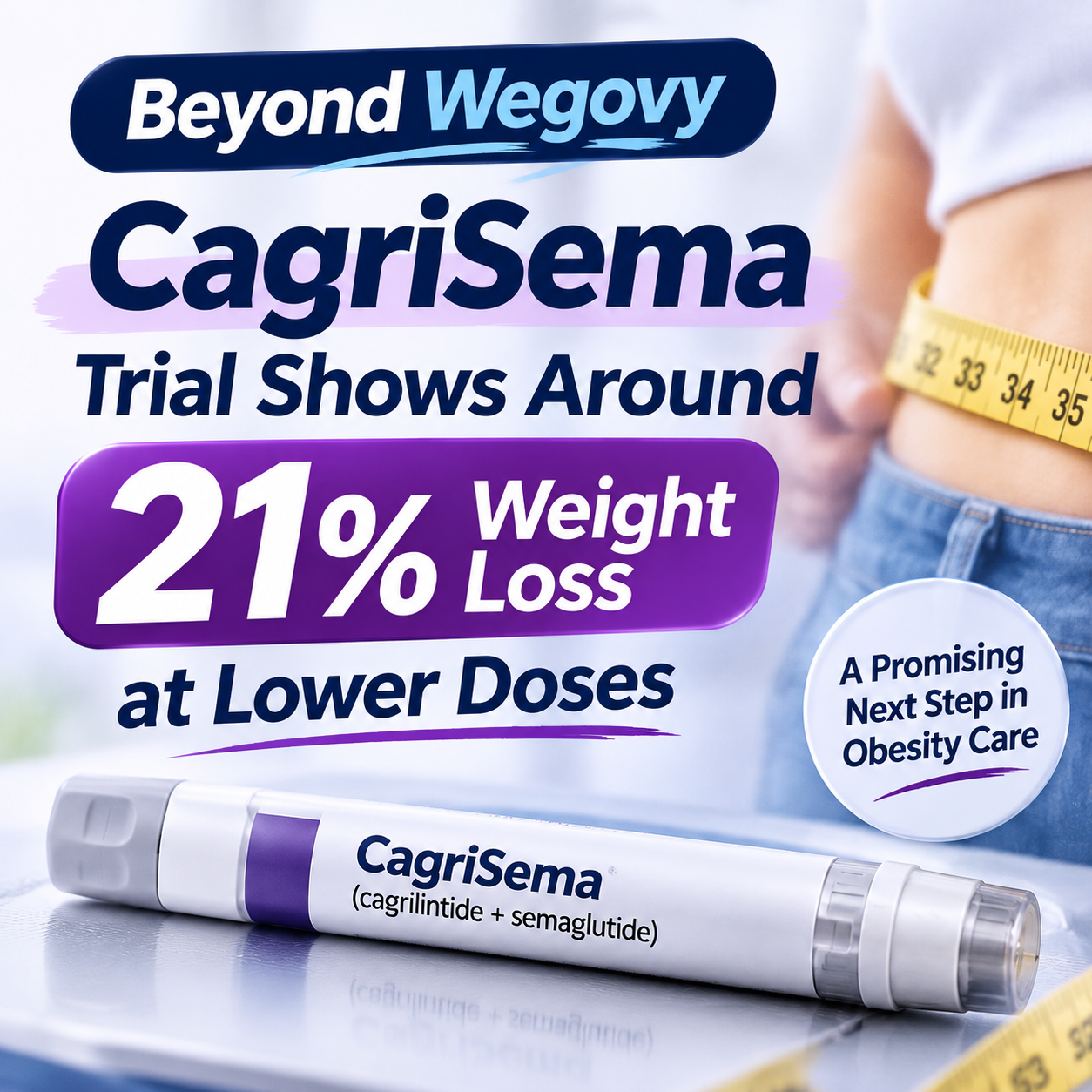
Could combining semaglutide with another appetite-regulating hormone deliver substantial weight loss at lower doses? New Phase 3 results released on November 14, 2026, suggest that CagriSema could become an important development in obesity treatment.
What Is CagriSema?
CagriSema is an investigational once-weekly injectable combination developed by Novo Nordisk.
It contains two active ingredients:
-
Semaglutide: A GLP-1 receptor agonist, also used in Wegovy and Ozempic.
-
Cagrilintide: A long-acting amylin analogue that acts on pathways involved in appetite and satiety.
The goal is to combine two complementary mechanisms involved in regulating food intake and body weight.
Unlike Wegovy, which contains semaglutide alone, CagriSema combines semaglutide with cagrilintide in one investigational treatment.
CagriSema is not an approved medication in the United States as of November 16, 2026.
What Happened in November 2026?
On November 14, Novo Nordisk announced results from the REDEFINE 9 Phase 3b trial at ObesityWeek 2026 in Washington, DC.
The findings were simultaneously published in The Lancet Diabetes & Endocrinology.
The study investigated whether lower doses of CagriSema could produce meaningful weight loss in adults with obesity or overweight.
Previous research had evaluated a higher combination dose of 2.4 mg cagrilintide plus 2.4 mg semaglutide.
REDEFINE 9 instead examined two lower-dose combinations.
REDEFINE 9: Study Design
The randomized trial included 309 adults without diabetes who had obesity or overweight with at least one weight-related complication.
Participants were assigned to one of two CagriSema dose groups or corresponding placebo treatment.
The active treatment groups received:
-
Cagrilintide 1.7 mg plus semaglutide 1.7 mg once weekly.
-
Cagrilintide 1.0 mg plus semaglutide 1.0 mg once weekly.
Treatment lasted 68 weeks, with nutritional and physical activity counseling also provided.
The primary outcomes included average percentage change in body weight and the proportion of participants losing at least 5% of their starting weight.
How Much Weight Did Participants Lose?
At week 68, the estimated average weight reductions under the efficacy estimand were:
| Treatment | Average weight reduction |
|---|---|
| CagriSema 1.7 mg + 1.7 mg | 20.7% |
| CagriSema 1.0 mg + 1.0 mg | 21.0% |
| Placebo | 2.0% |
Both active treatment groups achieved significantly greater weight loss than placebo.
Approximately 95.1% of participants in the 1.7 mg combination group and 96.3% in the 1.0 mg group were estimated to have lost at least 5% of their body weight, compared with 33.4% in the placebo group.
For perspective, a 21% reduction would represent approximately 21 kg for a person starting at 100 kg.
However, these figures are statistical estimates for the trial population, not guaranteed individual results.
Importantly, the trial was not designed to establish whether the 1.0 mg combination was more effective than the 1.7 mg combination.
The small numerical difference between their average results should not be interpreted as proof that a lower dose works better.
Why Are Lower Doses Important?
Obesity medications are often adjusted according to response and tolerability.
Investigating different doses can help researchers understand whether patients might achieve substantial benefits without necessarily requiring the highest studied dose.
Lower-dose options could eventually offer greater flexibility in treatment planning.
However, REDEFINE 9 does not establish that lower doses are universally safer or better tolerated than higher doses.
Direct comparisons would be needed to support that conclusion.
CagriSema vs. Wegovy vs. Mounjaro
| Medication | Active ingredient | Mechanism | Status |
|---|---|---|---|
| Wegovy | Semaglutide | GLP-1 receptor agonist | Approved for specified indications |
| Mounjaro | Tirzepatide | GIP/GLP-1 receptor agonist | Approved for specified indications, varying by country |
| CagriSema | Cagrilintide + semaglutide | Amylin analogue + GLP-1 receptor agonist | Investigational |
These medications are related to obesity and metabolic treatment, but their mechanisms are not identical.
The new REDEFINE 9 results should not be used to claim that CagriSema is superior to Wegovy or tirzepatide.
That would require appropriately designed comparative evidence.
What About Side Effects?
The most frequently reported adverse events in REDEFINE 9 were gastrointestinal, and most were mild or moderate.
Adverse events leading to permanent treatment discontinuation occurred in:
-
2.9% of the 1.7 mg combination group.
-
4.9% of the 1.0 mg combination group.
-
4.9% of the placebo group.
Overall adverse events were reported by 99% of participants receiving the 1.7 mg combination, 95% receiving the 1.0 mg combination, and 91% receiving placebo.
No deaths were reported.
These results describe the studied population and should not be interpreted as proof that CagriSema is free from serious risks.
Its full benefit-risk profile remains under regulatory evaluation.
Is CagriSema FDA-Approved?
No.
Novo Nordisk submitted a New Drug Application to the US FDA in December 2025 for CagriSema 2.4 mg + 2.4 mg for weight management.
As of November 16, 2026, a regulatory decision was expected during the fourth quarter of 2026.
The lower-dose combinations studied in REDEFINE 9 should not be confused with an approved product or approved dosing regimen.
Frequently Asked Questions
Is CagriSema the same as Wegovy?
No. Both contain semaglutide, but CagriSema also includes cagrilintide.
Did CagriSema really produce 21% weight loss?
The 1.0 mg + 1.0 mg group showed an estimated average reduction of 21.0% at 68 weeks under the efficacy estimand.
Does the lower dose work better?
That has not been established. The study was not powered to detect differences between the two active doses.
Is CagriSema available to purchase?
It is not an FDA-approved commercial treatment as of November 16, 2026.
Is it stronger than Mounjaro?
REDEFINE 9 did not directly compare CagriSema with tirzepatide, so superiority cannot be concluded.
Final Thoughts
The REDEFINE 9 findings highlight a promising direction in obesity research: combining complementary appetite-regulating pathways while exploring different dose levels.
Average weight-loss estimates of approximately 21% at 68 weeks are clinically meaningful findings, but the treatment remains investigational.
For patients and healthcare professionals, the key development is not simply a larger weight-loss percentage. It is the possibility of having more treatment options and dosing strategies in the future.
CagriSema may represent an important next step beyond semaglutide alone, but approval, long-term safety and individual treatment suitability remain essential questions.
This article is intended for pharmaceutical education and medical news reporting. Investigational medicines should not be represented as approved or commercially available treatments.
References
-
Novo Nordisk. REDEFINE 9 Phase 3 results, November 14, 2026.
https://www.novonordisk.com/news-and-media/news-and-ir-materials/news-details.html?id=920561 -
The Lancet Diabetes & Endocrinology. REDEFINE 9 randomized Phase 3b trial, November 2026.
https://doi.org/10.1016/S2213-8587(26)00275-5 -
ClinicalTrials.gov — REDEFINE 9, NCT06388187.
https://clinicaltrials.gov/study/NCT06388187