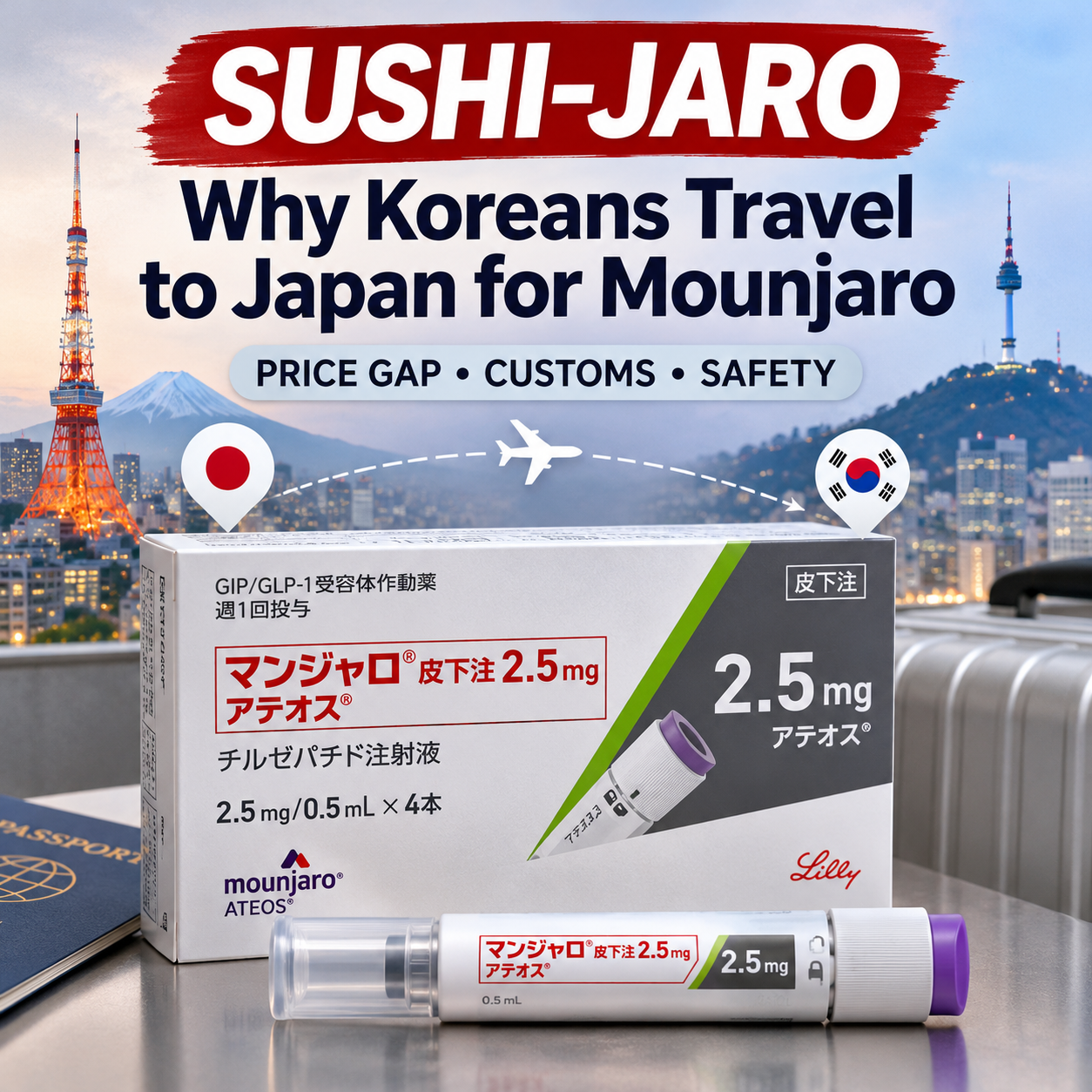
Sushi-jaro has become a buzzword in South Korea's weight-loss drug market. Behind the unusual name lies a growing debate about Mounjaro prices, medical tourism, customs seizures, and access to obesity treatment.
A new term has emerged in East Asia's rapidly expanding weight-loss medication market: Sushi-jaro, also written as Sushijaro.
Combining “sushi,” a symbol of Japan, with “Mounjaro,” Eli Lilly's tirzepatide medication, the nickname describes Mounjaro obtained in Japan, particularly by South Korean consumers seeking lower prices.
The trend has attracted international attention because of the substantial price difference between the two countries.
But the story is about more than inexpensive medication. It raises questions about prescription access, national health insurance, cross-border drug regulation, and patient safety.
1. What Exactly Is Sushi-jaro?
Sushi-jaro is not a new pharmaceutical product.
It is an informal nickname for Mounjaro purchased or prescribed in Japan.
Mounjaro contains tirzepatide, a once-weekly injectable medication that activates both glucose-dependent insulinotropic polypeptide (GIP) and glucagon-like peptide-1 (GLP-1) receptors.
These pathways help regulate blood glucose, appetite, and food intake.
Tirzepatide has demonstrated substantial weight-loss benefits in clinical trials involving appropriately selected patients.
However, approved indications differ by country and brand. In the United States, for example, tirzepatide is marketed as Mounjaro for type 2 diabetes and as Zepbound for specified weight-management indications.
The nickname Sushi-jaro does not indicate a special Japanese formulation or a different active ingredient.
Korean online communities have also used the term “India-jaro” when discussing lower-cost medicines obtained from India.
2. Why Is Mounjaro So Much Cheaper in Japan?
The main reason for the Sushi-jaro phenomenon is the difference in medication prices.
According to a June 23, 2026 report by Korea JoongAng Daily, a four-week supply of Mounjaro cost substantially less at certain Japanese providers than at some of the lowest-priced clinics in Seoul.
Reported Mounjaro prices in June 2026
| Four-week supply | South Korea | Japan |
|---|---|---|
| 2.5 mg | ₩290,000 | ₩74,000 |
| 10 mg | ₩540,000 | ₩294,000 |
At the 2.5 mg dose, the reported Japanese price was approximately 74% lower.
At 10 mg, the difference was approximately 46%.
These are reported provider prices, not guaranteed nationwide prices. They may change with the clinic, dosage, consultation fees, and market conditions.
Japan's drug-pricing system helps explain the difference.
Mounjaro is included in Japan's national health insurance drug-pricing framework for type 2 diabetes, allowing the government to regulate its reimbursement price.
Even when a prescription is not covered by insurance, regulated drug prices can influence what private clinics charge.
Competition among Japanese online medical providers has also contributed to lower prices.
In South Korea, patients receiving Mounjaro for weight management generally face substantial out-of-pocket expenses.
The resulting price gap has encouraged some consumers to compare the cost of domestic treatment with overseas medical visits.
3. How Did Sushi-jaro Become a Trend?
The nickname spread through online communities and social media as users discussed Japanese clinic prices and overseas prescriptions.
Some posts claimed that the savings on medication could offset the cost of a flight.
Others described purchasing several weeks or months of treatment during a visit to Japan.
These are accounts reported by journalists, not independently verified evidence that such trips are financially worthwhile or legally permissible.
Japanese-language coverage published through AFPBB News in October 2026 described medical providers advertising services to Korean visitors.
Reported offerings included Korean-language support and appointment arrangements designed for travelers.
However, there is no verified national count of people traveling specifically to obtain Sushi-jaro.
The trend is visible in media reports, but its total scale cannot be measured from social media anecdotes alone.
4. Customs Seizures: What Do the Numbers Show?
The growth of unauthorized imports is one of the most significant aspects of the story.
Data provided by the Korea Customs Service to lawmaker Seo Mi-hwa showed a sharp increase in detections during the first five months of 2026.
January–May 2026
| Import route | Detected cases |
|---|---|
| Travelers arriving through Incheon Airport | 289 |
| International mail | 2,940 |
| Combined total for these routes | 3,229 |
The 289 airport detections compared with 86 cases recorded between September and December 2025.
International-mail detections reached 2,940 cases in January–May 2026, compared with 1,107 during the whole of 2025.
Later reporting showed the problem continuing.
According to an October 2026 Seoul Economic Daily report citing customs data, 5,030 illegal import cases involving obesity medications were detected from January through August 2026, compared with 1,189 during all of 2025.
These statistics cover multiple medications, including Mounjaro and Wegovy.
They are not counts of Sushi-jaro alone, and they do not establish the number of individual purchasers.
International mail and travelers' baggage also represent different import channels, so their figures should not be confused.
5. Is Bringing Japanese Mounjaro Into Korea Legal?
A medicine being lawfully prescribed in Japan does not automatically make it lawful to import into South Korea.
Korean authorities have restricted unauthorized personal imports of Mounjaro and other obesity medications.
Customs officials may return or dispose of products that do not meet applicable import requirements.
Serious violations may also be investigated.
The distinction matters because three different issues are involved:
-
Whether the medication was legitimately prescribed and dispensed in Japan.
-
Whether its importation into South Korea is permitted.
-
Whether it has been stored and transported safely.
A foreign prescription does not resolve all three questions.
The increasing number of customs detections also shows why informal advice shared through social media should not be mistaken for regulatory guidance.
6. Why Are Medical Experts Criticizing Enforcement Alone?
The Sushi-jaro debate is not limited to customs violations.
Healthcare professionals and policymakers have argued that high domestic prices are a major reason patients seek alternatives abroad.
In the June 2026 Korea JoongAng Daily report, Oh Sang-woo, a professor of family medicine at Dongguk University Ilsan Hospital, supported recognizing severe obesity as a disease within the national health insurance framework.
Kim Dae-jung, a professor of endocrinology and metabolism at Ajou University Hospital, emphasized the need for long-term obesity treatment and the difficulty patients face when effective medicines remain expensive.
Lawmaker Seo Mi-hwa called for a broader approach addressing drug prices, prescription management, and patient safety alongside import enforcement.
These views reflect a wider policy debate.
Authorities emphasize preventing misuse and unauthorized distribution.
Critics argue that enforcement cannot fully address the economic pressures driving demand.
Both issues matter: improving affordability does not eliminate the need for medicine regulation, and stronger enforcement does not by itself make treatment more affordable.
7. What Are Japanese Health Authorities Warning About?
Japan has also expressed concern about inappropriate use of incretin-based medicines.
The Japanese Ministry of Health, Labour and Welfare has warned against casual use of diabetes medications for cosmetic slimming.
In June 2026, it issued guidance on the proper use of GLP-1 receptor agonists and dual GIP/GLP-1 receptor agonists.
In October, the ministry reiterated its warnings following concerns raised by the Japan Society for the Study of Obesity about ketosis-related complications.
Japan's Pharmaceuticals and Medical Devices Agency (PMDA) also published an English-language safety alert in October 2026.
The alert described reported adverse reactions associated with aesthetic or slimming use, including gastrointestinal symptoms, hypoglycemia, pancreatitis, and ketosis-related events.
These are reported safety events, not evidence that every patient will experience them.
Adverse-event reporting databases cannot establish the incidence of side effects among all users.
The warnings particularly concern inappropriate use outside approved indications, inadequate medical supervision, and excessive dietary restriction.
8. Why Do Storage and Medical Supervision Matter?
Mounjaro is a temperature-sensitive injectable medication.
Product-specific storage instructions generally require refrigeration, with limited exceptions depending on the device and market.
Improper transportation may create uncertainty about product quality.
Buying a genuine medicine from a legitimate clinic does not guarantee that it will remain suitable for use after improper storage.
Medical supervision is equally important.
Tirzepatide can cause gastrointestinal adverse effects and carries important warnings and precautions.
Treatment decisions also require consideration of medical history, contraindications, other medications, nutritional intake, and the patient's response.
Rapid weight loss without adequate nutrition or appropriate resistance exercise may contribute to loss of lean mass.
For these reasons, price should never be the only consideration when evaluating treatment.
9. Is Sushi-jaro Really Cheaper After Travel Costs?
The reported June 2026 prices provide a useful illustration.
A four-week 2.5 mg supply cost approximately ₩290,000 in South Korea and ₩74,000 in Japan.
That represents a medication-only difference of ₩216,000.
However, a complete cost comparison would also include medical consultation fees, transportation, accommodation, and currency exchange.
The financial calculation cannot be separated from the legal restrictions on importing the medication.
A lower overseas price does not automatically translate into an accessible or appropriate treatment option.
10. What Does Sushi-jaro Reveal About the Future of Obesity Treatment?
Sushi-jaro reflects a growing tension in global healthcare.
Medicines such as tirzepatide have changed expectations about medical weight management, but affordability remains a barrier for many patients.
National pricing and reimbursement systems can produce substantial differences in what patients pay for the same active ingredient.
When these differences become highly visible online, cross-border demand may increase.
The resulting challenges extend beyond individual purchasing decisions.
Healthcare systems must balance affordability, equitable access, appropriate prescribing, supply-chain integrity, and patient safety.
The central policy question is how patients who genuinely need treatment can obtain it through sustainable and medically supervised channels.
Frequently Asked Questions
Is Sushi-jaro different from Mounjaro?
No. Sushi-jaro is a nickname for Mounjaro obtained in Japan, not a separate medication.
Why is Japanese Mounjaro cheaper?
Japan's regulated pharmaceutical pricing framework and competition among private providers help explain the reported price difference.
Is Sushi-jaro available without a prescription?
Mounjaro is a prescription medication. Private-pay treatment does not make it an over-the-counter product.
Are all 5,030 customs detections related to Sushi-jaro?
No. The figure covers attempted illegal imports of several obesity medications through August 2026.
Can a Japanese prescription authorize importation into Korea?
Not automatically. Import requirements are separate from the rules governing prescription and dispensing in Japan.
Is tirzepatide effective for obesity treatment?
Clinical trials support its effectiveness in eligible patients, but approved indications and prescribing requirements vary by country and product.
Final Thoughts
Sushi-jaro may sound like a social media joke, but the economic and medical issues behind it are real.
The price difference between Japan and South Korea has made overseas Mounjaro prescriptions attractive to some consumers.
Meanwhile, rising customs detections have prompted stronger attention from regulators.
Healthcare experts have also questioned whether enforcement alone can address the underlying affordability problem.
The Sushi-jaro phenomenon is ultimately a story about the gap between the growing demand for effective obesity treatment and the ability of patients to access it safely and affordably.
At Zarvypharm, we believe accurate pharmaceutical information should explain not only how medicines work, but also the real-world issues affecting access, safety, and responsible use.
Medical Disclaimer: This article is for educational and news-reporting purposes. It does not encourage unauthorized imports, unsupervised use, or purchasing prescription medicines through unregulated channels.
Sources
-
Korea JoongAng Daily, June 23, 2026 — Obesity drug smuggling on the rise as foreign markets offer lower prices
https://www.koreajoongangdaily.com/korea/obesity-drug-smuggling-on-the-rise-as-foreign-markets-offer-lower-prices/12735705 -
Seoul Economic Daily, June 26, 2026 — Koreans Flock to Japan to Buy Cheaper Weight-Loss Drugs
https://en.sedaily.com/society/2026/06/26/koreans-flock-to-japan-to-buy-cheaper-weight-loss-drugs -
Seoul Economic Daily, October 10, 2026 — Koreans Fly to Japan for Cheap Obesity Drug as Seizures Surge
https://en.sedaily.com/international/2026/10/10/koreans-fly-to-japan-for-cheap-obesity-drug-as-seizures -
AFPBB News / KOREA WAVE, October 7, 2026 — Japanese-language reporting on Sushi-jaro
https://www.afpbb.com/articles/biz/3656444 -
Japan Ministry of Health, Labour and Welfare — Guidance on inappropriate cosmetic use of incretin-based medicines
https://www.mhlw.go.jp/stf/seisakunitsuite/bunya/kenkou_iryou/iyakuhin/kojinyunyu/index_00003.html -
Japan PMDA, October 2026 — Alert for Proper Use of Drugs, No. 18
https://www.pmda.go.jp/files/000283396.pdf