Updated November 2, 2026
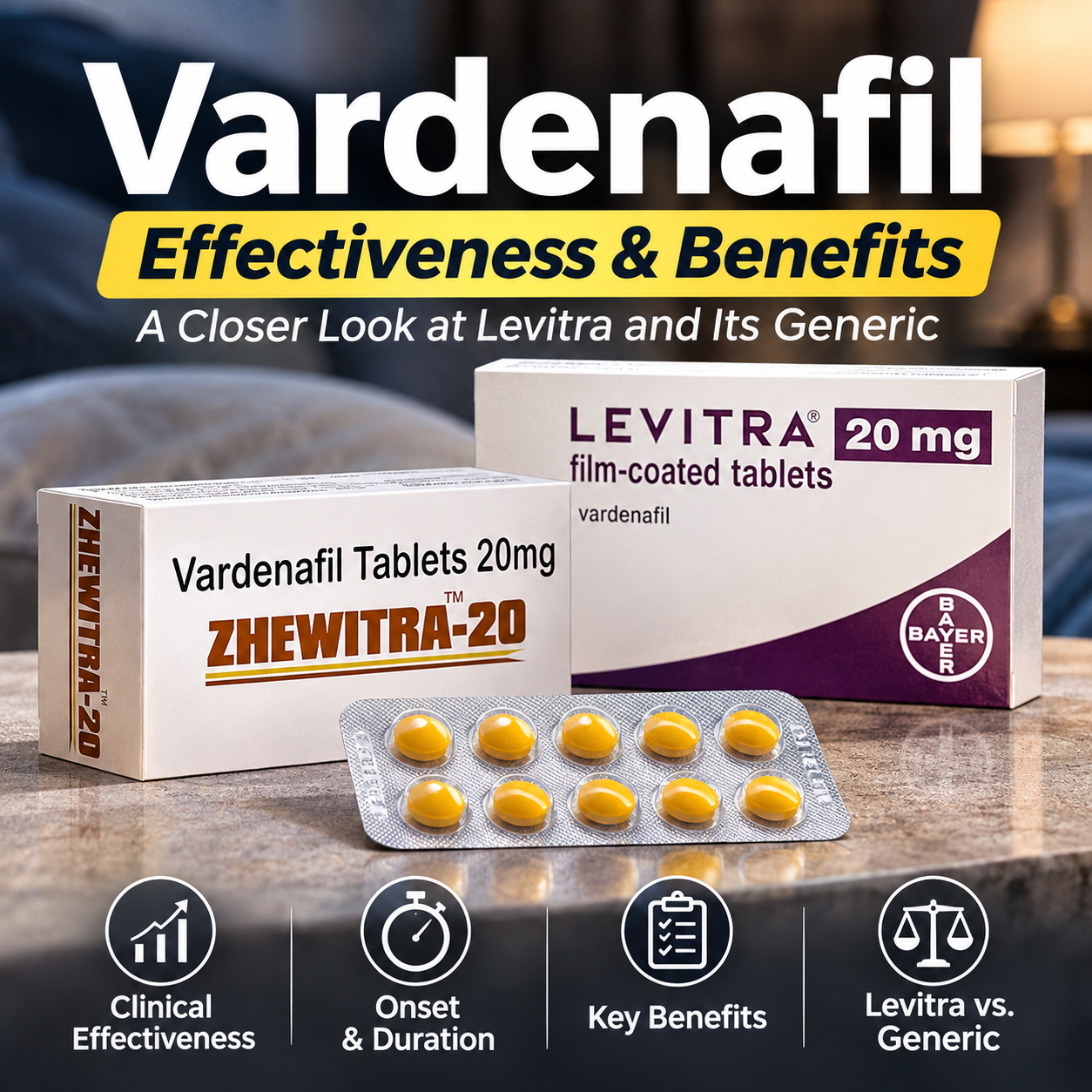
Can vardenafil really improve erection quality? Explore clinical success rates, how quickly Levitra works, its benefits for men with diabetes, and how it compares with sildenafil and tadalafil.
When people research erectile dysfunction (ED) treatments, sildenafil (Viagra) and tadalafil (Cialis) usually receive the most attention.
But another established medication deserves consideration: vardenafil, originally marketed as Levitra.
Vardenafil belongs to the same medication class as Viagra and Cialis, yet its effectiveness, duration, and individual tolerability make it a distinct treatment option.
More importantly, its benefits are supported by randomized clinical trials rather than marketing claims alone.
So how effective is vardenafil, and who might benefit from it?
1. What Is Vardenafil and How Does It Work?
Vardenafil is a phosphodiesterase type 5 (PDE5) inhibitor used to treat erectile dysfunction.
During sexual stimulation, the body releases nitric oxide, which helps increase cyclic guanosine monophosphate (cGMP) in penile tissue.
This process relaxes smooth muscle and supports blood flow into the penis.
PDE5 normally breaks down cGMP. By inhibiting this enzyme, vardenafil helps maintain the natural erectile response.
Its main benefits include:
-
Improving the ability to achieve an erection.
-
Helping maintain an erection during sexual activity.
-
Increasing the likelihood of satisfactory intercourse.
-
Supporting sexual confidence when erection difficulties are successfully treated.
However, vardenafil does not automatically produce an erection, directly increase libido, or permanently cure the underlying cause of ED.
Sexual stimulation remains necessary.
2. How Effective Is Vardenafil? Clinical Trial Results
One of the clearest demonstrations of vardenafil's effectiveness comes from a 12-week dose-response study summarized in the European Association of Urology (EAU) guidelines.
Percentage of men reporting improved erections:
| Treatment | Reported improvement |
|---|---|
| Vardenafil 5mg | 66% |
| Vardenafil 10mg | 76% |
| Vardenafil 20mg | 80% |
| Placebo | 30% |
These results demonstrate a substantial improvement compared with placebo.
The 10mg and 20mg groups reported particularly high rates of improvement.
However, these percentages describe men reporting better erections. They should not be interpreted as guaranteed intercourse success rates or the probability that every individual dose will work.
Clinical interpretation: Vardenafil has strong evidence for improving erectile function, but increasing the dose does not guarantee proportionally greater benefits.
3. How Quickly Does Vardenafil Work?
Vardenafil is generally taken approximately 60 minutes before anticipated sexual activity.
Clinical research indicates that some men may respond within approximately 30 minutes.
The EAU guidelines also describe a study in which roughly one-third of participants achieved satisfactory erections within 15 minutes.
That does not mean everyone can expect such a rapid response.
Onset varies with individual physiology, meal composition, stimulation, and other factors.
Vardenafil has an elimination half-life of approximately four hours, making it a shorter-acting alternative to tadalafil.
A high-fat meal may delay absorption of conventional vardenafil tablets.
For more predictable results, patients should follow their specific product instructions rather than assume that faster onset is guaranteed.
4. Can Vardenafil Help Men With Diabetes?
Diabetes is an important risk factor for erectile dysfunction.
Persistently elevated blood glucose can affect blood vessels and nerves involved in normal erections.
This may make ED more difficult to treat.
Fortunately, vardenafil has been evaluated in men with diabetes-related erectile dysfunction.
In a randomized, double-blind, placebo-controlled study involving men with type 1 diabetes, flexible-dose vardenafil (5–20mg) significantly improved measures of erection penetration and maintenance compared with placebo.
Improvements were observed across different categories of blood glucose control.
Why this matters: Vardenafil may remain effective even when erectile dysfunction is associated with a chronic metabolic condition.
However, response varies, and managing diabetes and cardiovascular risk remains essential.
5. Vardenafil vs Sildenafil vs Tadalafil: Which Is More Effective?
All three medications belong to the PDE5 inhibitor class and are established treatments for erectile dysfunction.
| Feature | Vardenafil | Sildenafil | Tadalafil |
|---|---|---|---|
| Original brand | Levitra | Viagra | Cialis |
| Typical starting dose | 10mg | 50mg | 10mg as needed |
| Approximate onset | 30–60 minutes | 30–60 minutes | 30–60 minutes |
| Duration profile | Shorter acting | Shorter acting | Up to 36 hours |
| Daily ED regimen | Not standard | Not standard | Available |
| Main practical benefit | Effective on-demand option | Extensive clinical experience | Extended flexibility |
A 2026 systematic review and network meta-analysis examined 83 randomized trials involving 6,029 participants.
The analysis supported the effectiveness of all four major PDE5 inhibitors, including vardenafil.
It suggested some comparative advantages for sildenafil in specific efficacy analyses, while tadalafil showed a favorable adverse-event profile in that dataset.
However, indirect comparisons have limitations, and the EAU guidelines do not establish that one PDE5 inhibitor is universally superior.
The practical conclusion: Vardenafil is a legitimate first-line pharmacological option, not necessarily a stronger replacement for Viagra or Cialis.
Individual response and tolerability remain decisive.
6. Does Vardenafil Improve Sexual Confidence?
Erectile dysfunction can create a cycle of worry and performance pressure.
A previous unsuccessful sexual experience may increase anxiety about the next encounter.
When treatment improves erection reliability, some men may feel more relaxed and confident.
This psychological benefit can contribute to overall sexual satisfaction.
However, vardenafil is not an approved treatment for anxiety or depression.
Men with persistent performance anxiety may benefit from psychological or psychosexual support alongside medical treatment.
7. Vardenafil 5mg, 10mg, or 20mg: What Is the Difference?
Vardenafil is available in different strengths to accommodate individual treatment needs.
5mg: A lower-dose option that may be appropriate for patients requiring reduced exposure, including certain older adults or people with specific medical conditions.
10mg: The usual recommended starting dose for many adults using conventional tablets.
20mg: The maximum commonly recommended single dose, reserved for patients who require it and can tolerate treatment.
Vardenafil should not be taken more than once daily.
Certain medications, liver conditions, and other risk factors may require lower maximum doses or avoidance of treatment.
A higher dose is not automatically more effective for every patient.
8. What About Orally Disintegrating Vardenafil Tablets?
Vardenafil has also been developed in orally disintegrating tablet (ODT) formulations.
These dissolve on the tongue and may be convenient for people who dislike swallowing conventional tablets.
Clinical studies have demonstrated effectiveness comparable to conventional formulations.
However, ODT and standard tablets may differ in bioavailability and prescribing instructions.
They should not automatically be substituted milligram for milligram.
Availability and approved instructions vary by country.
9. Side Effects and Important Safety Precautions
Common adverse effects include:
-
Headache.
-
Facial flushing.
-
Nasal congestion.
-
Indigestion.
-
Dizziness.
Most adverse effects are mild or temporary, but serious reactions are possible.
Vardenafil must not be combined with nitrate medications or recreational nitrites because severe hypotension may occur.
It is also contraindicated with riociguat.
An important distinction: Vardenafil carries specific warnings about QT interval prolongation. People with congenital long QT syndrome or taking certain class IA or class III antiarrhythmic medications should avoid it.
Interactions with alpha-blockers, blood-pressure medications, and strong CYP3A4 inhibitors also require attention.
Seek urgent medical care for chest pain, sudden vision or hearing loss, or an erection lasting longer than four hours.
10. Is Vardenafil Still Relevant in 2026?
Absolutely.
Although sildenafil and tadalafil receive more public attention, vardenafil remains an evidence-based option for treating erectile dysfunction.
The 2026 EAU guidelines continue to recognize PDE5 inhibitors as first-line pharmacological treatment.
Meanwhile, comparative research published in 2026 reinforces that treatment decisions should account for effectiveness, tolerability, medical history, and patient preference.
Vardenafil may be particularly relevant for men who prefer an on-demand treatment window or who have not found their current ED medication satisfactory.
However, switching medications should be guided by medical assessment, not assumptions that one drug is inherently stronger.
11. Frequently Asked Questions
Is vardenafil stronger than Viagra?
Not necessarily. Both are effective PDE5 inhibitors, and clinical evidence does not establish vardenafil as universally superior.
How long does vardenafil last?
Its effects generally cover several hours. Its approximately four-hour elimination half-life is much shorter than tadalafil's.
Can vardenafil work within 15 minutes?
Some study participants responded that quickly, but this is not a reliable expectation for everyone.
Does vardenafil work for diabetic erectile dysfunction?
Clinical trials demonstrate benefits in men with diabetes-related ED, although individual responses vary.
Can I take vardenafil every day?
Conventional vardenafil is prescribed as needed, no more than once daily. It is not a standard continuous daily ED regimen.
Does vardenafil increase sexual desire?
No. It supports the erectile response to sexual stimulation rather than directly increasing libido.
Final Thoughts
Vardenafil deserves recognition as an effective, clinically established treatment for erectile dysfunction.
Its strongest advantages are demonstrated improvements in erection quality, established on-demand dosing, and evidence of effectiveness in men with diabetes-related ED.
The clinical data are encouraging: in one 12-week study, 76% of men taking 10mg and 80% taking 20mg reported improved erections, compared with 30% receiving placebo.
Yet successful treatment is not simply about choosing the highest dose or the most powerful-sounding medication.
The best ED treatment is the one that provides reliable benefits with acceptable side effects and fits the patient's medical needs.
At Zarvypharm, our goal is to provide clear, practical, evidence-based information about established medications.
Medical Disclaimer: This article is for educational purposes only and does not replace professional medical advice. Vardenafil should be used only under appropriate medical guidance.
References
-
European Association of Urology. Guidelines on Sexual and Reproductive Health — Management of Erectile Dysfunction.
https://uroweb.org/guidelines/sexual-and-reproductive-health/chapter/management-of-erectile-dysfunction -
DailyMed. Vardenafil Hydrochloride Tablets: Prescribing Information, revised August 2026.
https://www.dailymed.nlm.nih.gov/dailymed/fda/fdaDrugXsl.cfm?setid=6d2859a7-6def-455f-856b-9db86b1fd355&type=display -
A Comparative Evaluation of On-Demand Phosphodiesterase-5 Inhibitor Efficacy in Erectile Dysfunction Treatment: A Systematic Review and Network Meta-Analysis. The Journal of Sexual Medicine, 2026.
https://pubmed.ncbi.nlm.nih.gov/42296271/ -
Efficacy and Safety of Flexible-Dose Vardenafil in Men With Type 1 Diabetes and Erectile Dysfunction. Randomized clinical trial.
https://pubmed.ncbi.nlm.nih.gov/16942532/