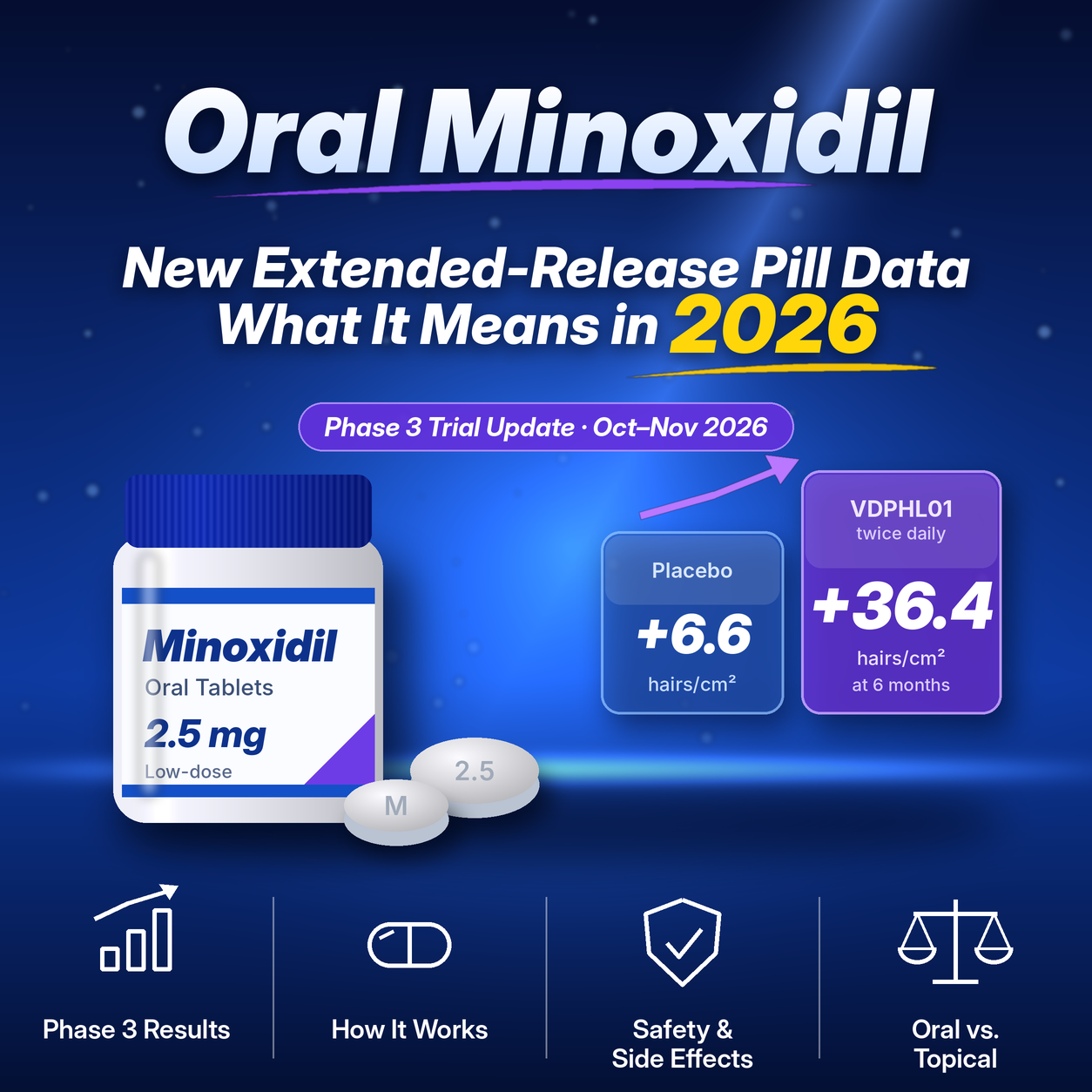
Oral minoxidil has quietly become one of the most talked-about hair loss treatments of the decade. Dermatologists have prescribed low-dose tablets off-label for years, and in 2026 the story moved up a gear: a purpose-built, extended-release oral minoxidil pill called VDPHL01 delivered positive Phase 3 results in men, followed by 12-month data in November. Here is what the new research shows, how it compares with the low-dose oral minoxidil already in use, and what it means if you are treating hair loss today.
What is oral minoxidil?
Minoxidil was first developed as a tablet for severe high blood pressure. It works as a vasodilator, relaxing the smooth muscle in blood vessel walls. Doctors noticed unwanted hair growth as a side effect, which led to the topical solutions and foams (Rogaine and its generics) approved for pattern hair loss.
In the hair follicle, minoxidil has to be converted into its active form, minoxidil sulfate, by an enzyme called sulfotransferase. People with low follicular sulfotransferase activity often respond poorly to topical minoxidil, and swallowing the drug is one way to get around that. Low-dose oral minoxidil (LDOM) is also easier for many people to stick with than applying a liquid to the scalp once or twice a day.
Important: oral minoxidil is approved in the US only as a blood pressure medicine, at doses of 10–40 mg per day. Its use for hair loss at low doses is off-label.
The 2026 news: VDPHL01, an extended-release oral minoxidil
VDPHL01 is being developed by Veradermics as a once- or twice-daily extended-release tablet designed specifically for pattern hair loss. The idea is to keep blood levels of minoxidil steady instead of producing the sharp peaks seen with standard immediate-release tablets, which were designed for hypertension.
Phase 3 Study '304' (men, October 2026)
On October 19, 2026, Veradermics reported that Study 304, a Phase 3 trial in 536 men with mild-to-moderate pattern hair loss, met all primary and secondary endpoints. After six months on VDPHL01 8.5 mg:
- Hair count: non-vellus hair count in the target area rose by 28.6 hairs/cm² with once-daily dosing and 36.4 hairs/cm² with twice-daily dosing, versus 6.6 hairs/cm² with placebo.
- Patient-reported outcome: 55.7% (once daily) and 68.7% (twice daily) of men rated their hair "improved" or "much improved", versus 15.0% on placebo.
- Investigator assessment: investigators graded 78.4% and 82.7% of participants as having improved hair coverage.
12-month data from Study '302' (November 2026)
An earlier Phase 2/3 trial, Study 302, enrolled 519 men. Its six-month results (April 2026) were similar to those of Study 304: an increase of 30.3 and 33.0 hairs/cm² versus 7.3 hairs/cm² with placebo. On November 9, 2026, the company released 12-month data. In men who stayed on twice-daily VDPHL01, hair count kept rising, to 43.9 hairs/cm² above baseline, up from about 33 at month 6. No adverse events led anyone to stop treatment between months 6 and 12.
What about women?
In Study 207, a Phase 2 trial, women took 4.5 mg once or twice daily. After six months, hair count rose by 22.7 and 23.3 hairs/cm², and about 89–90% of participants reported improvement. A larger Phase 2/3 study in 556 women (Study 306) is fully enrolled, with results expected in the first half of 2027. No oral prescription treatment has ever been FDA-approved for female pattern hair loss.
Safety signals so far
Across the male trials, the most common side effects were the ones you would expect from minoxidil:
| Side effect (6 months) | Once daily | Twice daily | Placebo |
|---|---|---|---|
| Peripheral edema (Study 304) | 2.8% | 4.5% | 0.6% |
| Unwanted body/facial hair (hypertrichosis, Study 304) | 2.2% | 9.0% | 0% |
The company reported no treatment-related serious adverse events and no cardiac adverse events of special interest in Study 304.
Bottom line: VDPHL01 is still investigational. It is not FDA-approved, and no regulatory submission date has been confirmed. It will not be available to buy until it is approved.
How does today's low-dose oral minoxidil compare?
You do not have to wait for VDPHL01 to use oral minoxidil. Generic minoxidil tablets are widely prescribed at low doses, and the evidence behind them keeps growing:
- Expert consensus (JAMA Dermatology, 2025): 43 hair loss specialists from 12 countries agreed on recommendations for off-label low-dose oral minoxidil, typically 0.625–5 mg daily, for several types of hair loss in adults and adolescents. They also noted that large trials and formal guidelines are still lacking.
- Oral vs. topical: a randomized trial summarized in American Family Physician (2025) found that 5 mg oral minoxidil once daily was roughly as effective as 5% topical minoxidil in men over 24 weeks. Oral dosing was slightly better for hair density on the crown.
- 2.5 mg vs. 5 mg: a 2025 trial in the Journal of the American Academy of Dermatology found that 2.5 mg daily produced regrowth comparable to 5 mg in men with androgenetic alopecia.
Typical starting doses for hair loss are much lower than blood pressure doses: often 2.5–5 mg for men and 0.625–2.5 mg for women. Doctors usually start low and adjust based on response and side effects.
Oral minoxidil options at Zarvypharm
Zarvypharm stocks both oral and topical minoxidil from Indian manufacturers, plus combinations with DHT blockers:
- Minoxyvy 2.5 mg and 5 mg tablets: low-dose oral minoxidil in the strengths most often used for hair loss.
- MINWIN-F tablets (minoxidil 5 mg + finasteride 1 mg): a single daily tablet that combines a growth stimulant with a DHT blocker.
- MINWIN-D tablets (minoxidil 5 mg + dutasteride 0.5 mg): for people whose doctor prefers dutasteride.
- Topical options: Rogaine 5% solution, Tugain 10% solution and foam, and Morr F (minoxidil + finasteride 0.1%) for people who prefer to avoid tablets.
- Finasteride: Propecia and Finpecia 1 mg, the most-reviewed hair loss products in our store.
Minoxidil and DHT blockers work in different ways, so dermatologists often combine them. For a closer look at the DHT-blocker side, read our guide Finasteride vs. Dutasteride in 2026.
Side effects and who should be careful
Low-dose oral minoxidil is generally well tolerated, but it is a blood pressure drug. Possible side effects include:
- Unwanted hair growth on the face or body, the most common reason people stop
- Swelling of the ankles or feet (fluid retention)
- Fast heartbeat, palpitations, dizziness or lightheadedness
- Temporary shedding during the first 2–8 weeks as old hairs make way for new growth
- Rarely, fluid around the heart (pericardial effusion), mainly reported at higher doses
Speak to a doctor before using oral minoxidil if you have heart disease, low blood pressure, kidney problems or a history of pheochromocytoma, or if you take other blood pressure medicines. It should not be used during pregnancy or breastfeeding. Seek urgent medical care if you develop chest pain, shortness of breath or rapid weight gain from swelling.
FAQ
Is oral minoxidil better than topical minoxidil?
Studies suggest similar results at standard doses, with oral minoxidil being more convenient and helpful for people who don't respond to topical. Oral dosing carries more body-wide side effects such as unwanted hair growth.
When will VDPHL01 be available?
It has not yet been approved. Data from the female study are expected in the first half of 2027. Any approval would follow an FDA review, so availability is unlikely before 2027 at the earliest.
How long does oral minoxidil take to work?
Most people see early changes at 3 months and clearer results at 6–12 months. In the VDPHL01 trials, differences from placebo were measurable from month 2.
Can I take oral minoxidil with finasteride?
Yes, the combination is common in dermatology practice because the two drugs act on different pathways. Combination tablets such as MINWIN-F put both in one pill.
Will I lose the hair if I stop?
Yes. Like all current pattern hair loss treatments, the benefit fades over several months after stopping.
The takeaway
2026 has been a landmark year for oral minoxidil. Positive Phase 3 data for an extended-release pill built for hair loss confirm what many dermatologists already see in practice: taking minoxidil by mouth works, and steadier dosing may improve both results and tolerability. Until VDPHL01 reaches the market, low-dose generic oral minoxidil, alone or combined with finasteride or dutasteride, remains the practical option. Speak with a healthcare provider about the dose that is right for you.
Disclaimer: This article is for informational purposes only and does not replace advice from a qualified healthcare professional. Oral minoxidil for hair loss is an off-label use. Always consult a doctor before starting, stopping or changing any medication.
References
- Veradermics. Oral VDPHL01 achieved early, consistent and robust hair growth in positive Phase 3 '304' clinical trial in male pattern hair loss. Business Wire, October 19, 2026.
- Veradermics. 12-month Study '302' data in male pattern hair loss. Business Wire, November 9, 2026. Also covered by Dermatology Times, November 10, 2026.
- Veradermics. Positive Study '207' Phase 2 results in female pattern hair loss. Business Wire, July 15, 2026.
- Fierce Pharma. Veradermics' hot streak continues with another phase 3 win in hair loss. October 2026.
- Oral minoxidil for hair loss: expert consensus statement. JAMA Dermatology, 2025.
- Oral minoxidil, 5 mg once daily, is similarly effective as topical minoxidil. American Family Physician, 2025;111(2):181.
- Low-dose oral minoxidil 2.5 mg vs 5 mg in androgenetic alopecia. Journal of the American Academy of Dermatology, 2025.