November 13, 2026 | Zarvypharm Health News
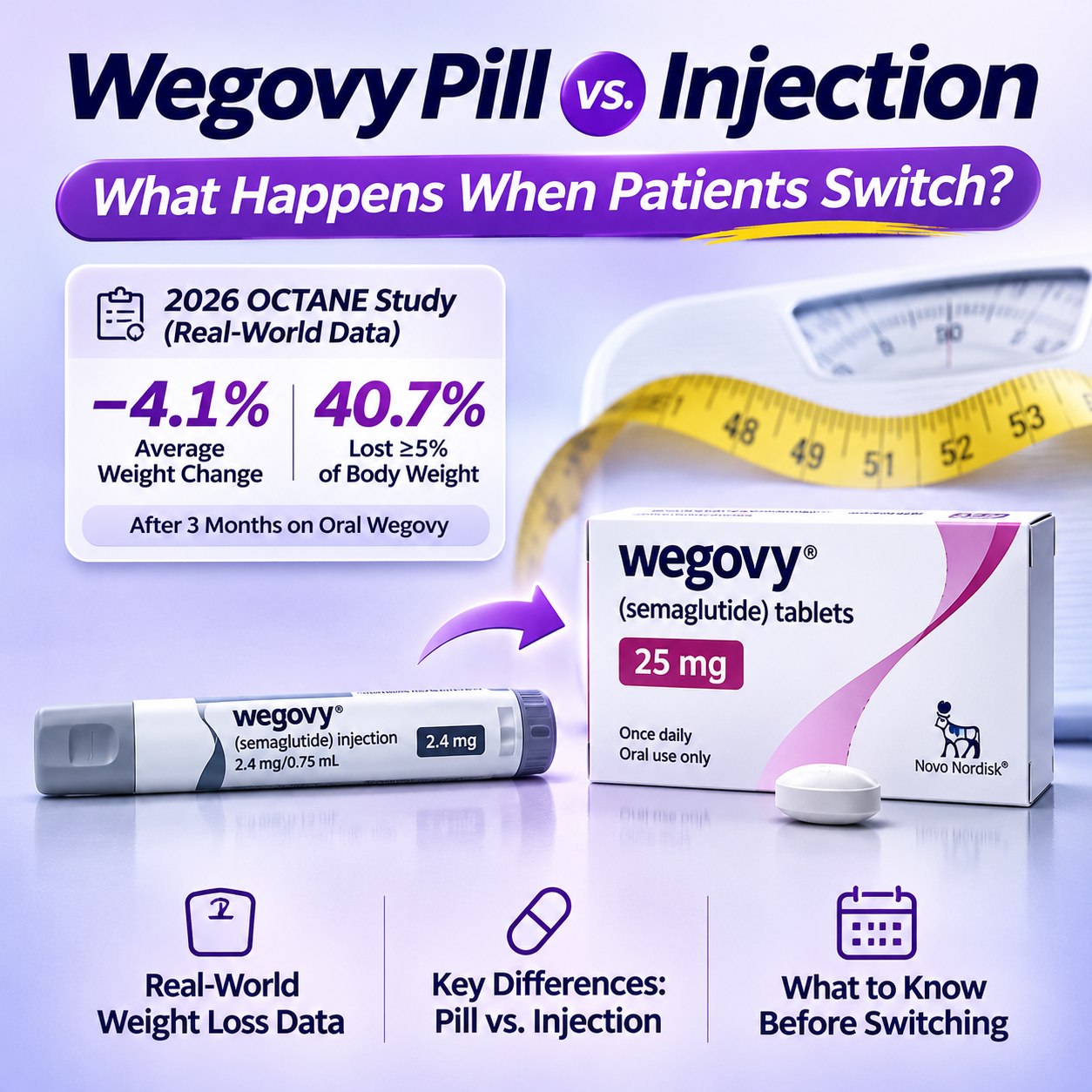
Can patients continue losing weight after switching from injectable Wegovy or Mounjaro to the new Wegovy pill? A 2026 real-world study provides an early look at what happens when people move from weekly weight-loss injections to once-daily oral semaglutide.
For years, injectable GLP-1 medications have dominated the conversation about medical weight management. Wegovy, containing semaglutide, and Mounjaro, containing tirzepatide, have become widely recognized treatments.
Now the arrival of the Wegovy pill is introducing another option.
Approved by the US Food and Drug Administration in December 2025 and launched in the United States in January 2026, oral Wegovy offers an alternative for eligible adults who prefer tablets to injections.
But one question matters particularly to existing GLP-1 users: What happens to weight loss when patients switch from an injection to a pill?
1. The 2026 OCTANE Study: A New Look at Switching
On September 30, 2026, Novo Nordisk announced findings from the OCTANE study at the European Association for the Study of Diabetes (EASD) meeting.
OCTANE analyzed real-world data from adults who switched from injectable semaglutide or tirzepatide to once-daily oral semaglutide.
The analysis included 194 adults with obesity or overweight and at least one obesity-related health condition.
Participants had a mean starting weight of 100.5 kg and a mean body mass index (BMI) of 34.5 kg/m².
All included participants remained on oral semaglutide during the three-month observation period.
This was a retrospective observational analysis, not a randomized trial directly comparing injections with tablets.
2. How Much Weight Did Patients Lose?
The study reported the following results after three months of oral Wegovy treatment:
| Outcome | Result |
|---|---|
| Average weight reduction | 4.1% |
| Average weight reduction in kilograms | 4.0 kg |
| Participants losing at least 5% of body weight | 40.7% |
| Average starting weight | 100.5 kg |
| Study population | 194 adults |
For a person weighing 100 kg at the beginning of oral treatment, a 4.1% reduction would correspond to approximately 4.1 kg.
Importantly, this was weight lost during the observation period after switching, not necessarily the participant's total weight loss since first starting GLP-1 therapy.
The results suggest that some patients may continue losing weight after transitioning to an oral formulation.
However, because the analysis included only patients who remained on treatment for three months, it cannot establish how frequently switching succeeds among all patients who attempt it.
3. Wegovy Pill vs. Injection: What's Different?
Both versions of Wegovy contain semaglutide, a glucagon-like peptide-1 (GLP-1) receptor agonist.
Semaglutide helps regulate appetite, food intake and blood glucose through GLP-1 receptor activity.
The primary difference is how the medication is administered.
| Feature | Wegovy injection | Wegovy pill |
|---|---|---|
| Active ingredient | Semaglutide | Semaglutide |
| Administration | Subcutaneous injection | Oral tablet |
| Frequency | Once weekly | Once daily |
| Typical weight-management maintenance dose | 2.4 mg weekly | 25 mg daily |
| Starting dose | 0.25 mg weekly | 1.5 mg daily |
| Main convenience advantage | Less frequent dosing | No injections |
The tablet and injection doses are not directly interchangeable on a milligram-for-milligram basis.
Patients should follow the specific prescribing instructions when changing formulations.
4. Does the Wegovy Pill Work as Well as the Injection?
The pivotal OASIS 4 clinical trial evaluated oral semaglutide 25 mg in adults with obesity or overweight and at least one weight-related condition.
Novo Nordisk reported an average weight reduction of 16.6% after 64 weeks in the analysis estimating outcomes when treatment was followed as intended.
This was not the average outcome for every person who started treatment.
The injectable Wegovy 2.4 mg formulation has also demonstrated substantial weight reduction in separate clinical trials.
However, comparing percentages from different trials does not establish that oral and injectable Wegovy have identical effectiveness.
Differences in study populations, duration, adherence and statistical analysis can affect results.
The OCTANE study provides useful information about switching in real-world practice, but it does not prove that tablets are superior, equivalent or inferior to injections.
5. Why Are Patients Interested in Switching?
Several practical factors may influence a patient's preference.
Avoiding injections: Some patients dislike needles or experience anxiety around self-injection.
Travel and convenience: Tablets eliminate the need to administer injections, although daily medication routines and storage requirements still matter.
Treatment preferences: Patients may prefer a daily oral routine rather than a weekly injection schedule.
Access and affordability: Availability, insurance coverage and out-of-pocket costs can influence treatment choices.
The OCTANE study also examined patient-reported experiences.
Among participants with available questionnaire data, 82.4% reported at least one perceived improvement, including better-fitting clothing or healthier eating habits.
These were self-reported observations, not independently confirmed improvements in every participant.
6. The Important Catch: How to Take Oral Wegovy
Oral Wegovy has more specific administration requirements than many conventional tablets.
According to US prescribing information, the tablet should be taken:
-
In the morning on an empty stomach.
-
With no more than 4 ounces (approximately 120 mL) of plain water.
-
At least 30 minutes before eating, drinking or taking other oral medications.
The tablet must be swallowed whole.
These instructions matter because food, beverages and other medications can interfere with semaglutide absorption.
The convenience of avoiding injections must therefore be balanced against the need for consistent daily administration.
7. What About Side Effects?
Oral and injectable Wegovy share many adverse effects associated with GLP-1 receptor agonists.
Common reactions include nausea, vomiting, diarrhea, constipation and abdominal discomfort.
Both formulations carry important warnings, including a boxed warning concerning thyroid C-cell tumors observed in rodents.
Wegovy is contraindicated in patients with a personal or family history of medullary thyroid carcinoma or multiple endocrine neoplasia syndrome type 2.
Other important precautions concern pancreatitis, gallbladder disease, dehydration-related kidney injury and certain medication interactions.
Patients should not combine oral and injectable Wegovy or use Wegovy with other semaglutide-containing products.
8. Can Patients Switch From Mounjaro to Wegovy Pills?
The OCTANE study included participants previously treated with injectable tirzepatide as well as injectable semaglutide.
However, tirzepatide and semaglutide are different active ingredients.
Tirzepatide acts on both GIP and GLP-1 receptors, whereas semaglutide acts on GLP-1 receptors.
A patient switching from Mounjaro to oral Wegovy is therefore changing both the active ingredient and the dosage form.
There is no simple milligram-to-milligram conversion between these medications.
Switching decisions require assessment of previous treatment response, tolerability, current dose and the appropriate starting schedule for the new medication.
Frequently Asked Questions
Is the Wegovy pill FDA-approved?
Yes. Oral Wegovy received US FDA approval in December 2025 for specified adult indications.
How much weight did patients lose after switching?
In the OCTANE analysis, the average reduction was 4.1% over three months among 194 patients who remained on oral treatment.
Is the pill stronger than the injection?
No direct conclusion can be drawn from OCTANE. It was not a randomized head-to-head comparison.
Is oral Wegovy the same as Rybelsus?
Both contain semaglutide, but they have different approved indications, dosing regimens and product labeling. They should not be treated as interchangeable products.
Can patients take the Wegovy pill with breakfast?
No. The US label specifies taking it on an empty stomach and waiting at least 30 minutes before food, drinks or other oral medicines.
Is oral Wegovy available worldwide?
No. Regulatory approvals and commercial availability differ by country.
Final Thoughts
The introduction of oral Wegovy marks an important development in obesity treatment.
The 2026 OCTANE study found that selected patients who switched from injectable GLP-1 therapy to oral semaglutide continued losing weight during a three-month observation period.
That is an encouraging real-world finding, but it is not proof that switching will work equally well for everyone.
The future of obesity treatment may offer patients more flexibility—not necessarily a single formulation that is best for everyone.
This article is intended for pharmaceutical education and medical news reporting. Medication changes should follow approved prescribing information and individualized clinical assessment.
References
-
Novo Nordisk, September 30, 2026 — OCTANE real-world switching study.
https://www.novonordisk-us.com/media/press-releases/wegovy-pill-octane-study-real-world-data.html -
Novo Nordisk, December 22, 2025 — FDA approval of oral Wegovy.
https://www.novonordisk.com/news-and-media/news-and-ir-materials/news-details.html?id=916472 -
US FDA — Wegovy tablets and injection prescribing information, 2026.
https://www.accessdata.fda.gov/drugsatfda_docs/label/2026/215256s030lbl.pdf -
Reuters, January 5, 2026 — Launch of Wegovy pill in the United States.
https://www.reuters.com/sustainability/boards-policy-regulation/novo-nordisk-sell-wegovy-pill-us-self-pay-patients-starting-149-per-month-2026-01-05/