Published November 6, 2026 | Zarvypharm Health News
Could combining tirzepatide with a new hormone-based medicine improve weight loss beyond Mounjaro alone? New Phase 2 clinical trial results presented at EASD 2026 offer an intriguing answer—but important questions remain.
Tirzepatide has already changed the global conversation about obesity treatment. Known under the brand names Mounjaro and Zepbound, the medication targets two metabolic hormone pathways and has demonstrated substantial benefits for weight management and blood glucose control.
Now researchers are investigating whether adding a third hormonal mechanism could improve those results.
At the European Association for the Study of Diabetes (EASD) meeting on September 30, 2026, Eli Lilly presented Phase 2 data evaluating eloralintide combined with tirzepatide.
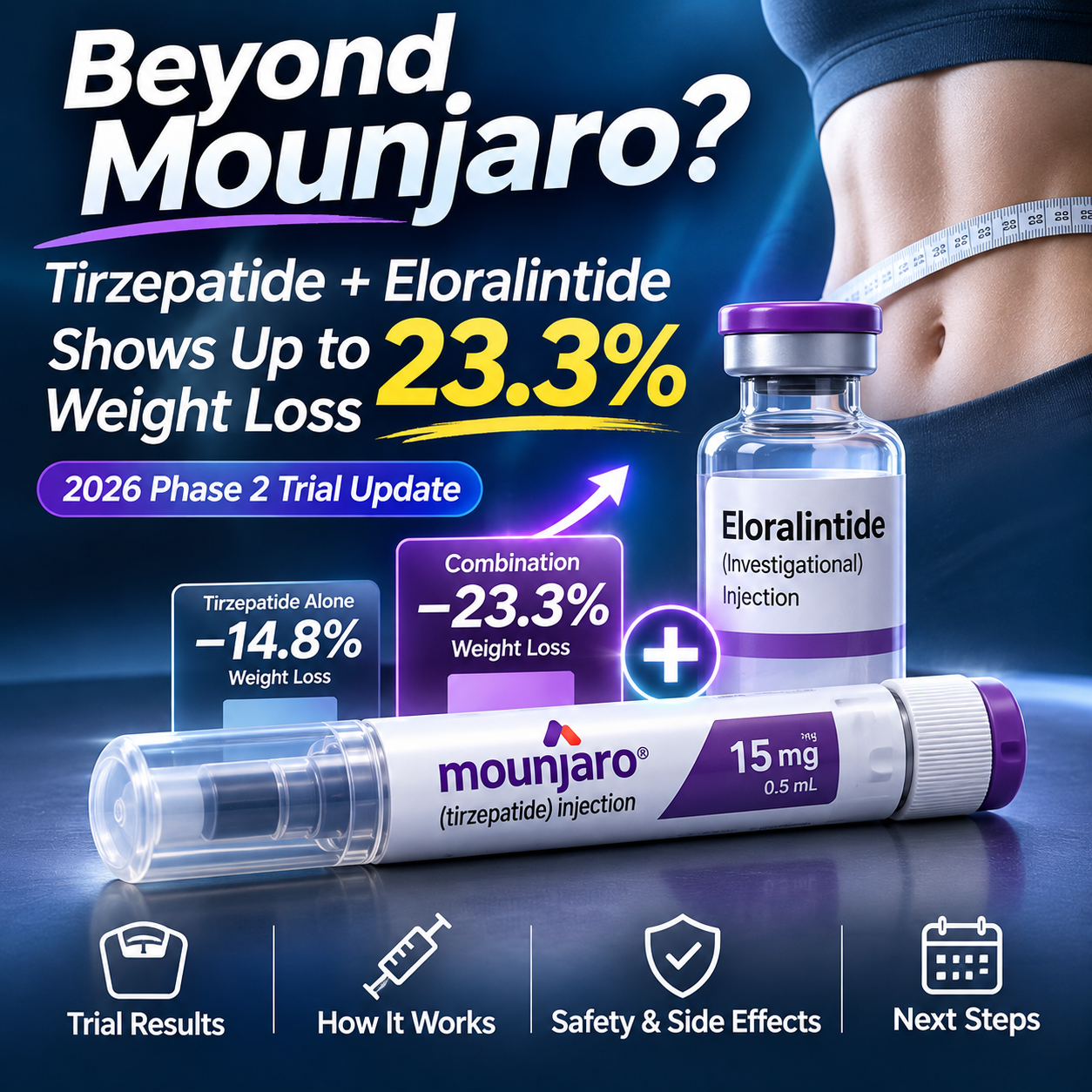
In adults with obesity or overweight and type 2 diabetes, the highest-performing combination group achieved an estimated average body-weight reduction of 23.3% after 48 weeks.
For comparison, participants assigned to tirzepatide 15 mg alone had an estimated average reduction of 14.8% in the same study.
The findings suggest a potentially important direction for obesity treatment. However, the combination remains investigational, and its long-term benefits and risks require further evaluation.
1. What Is Eloralintide, and Why Combine It With Tirzepatide?
Tirzepatide is a dual agonist of glucose-dependent insulinotropic polypeptide (GIP) and glucagon-like peptide-1 (GLP-1) receptors.
Its effects include improved glucose regulation and reduced appetite and food intake.
Eloralintide works differently.
It is an investigational, selective amylin receptor agonist designed to act on a hormonal pathway involved in satiety and food intake.
Amylin is a hormone naturally released alongside insulin. Its signaling contributes to feelings of fullness and the regulation of eating behavior.
Researchers are investigating whether targeting amylin receptors alongside GIP and GLP-1 receptors can produce additional weight-loss benefits.
This is a combination of two investigational treatment components in a clinical trial—not a new version of commercially available Mounjaro.
2. What Did the 2026 Clinical Trial Investigate?
The Phase 2 study, identified as NCT06603571, enrolled 367 randomized participants with obesity or overweight and type 2 diabetes.
Participants had a body mass index of at least 27 kg/m² and an HbA1c level between 7.0% and 10.5%.
The study was randomized, double-blind and placebo-controlled, with 10 treatment groups.
Researchers evaluated eloralintide alone, tirzepatide alone, several dose combinations, and placebo over 48 weeks.
The primary outcome was the percentage change in body weight.
Secondary and exploratory outcomes included changes in HbA1c, weight-loss thresholds and safety.
The trial was designed to explore the effectiveness and tolerability of the treatments, not to establish that the combination is ready for routine prescribing.
3. The Weight-Loss Results: 23.3% vs. 14.8%
The most attention-grabbing result was the difference between the highest-performing combination group and tirzepatide alone.
Estimated average weight change at 48 weeks
| Treatment | Body-weight change |
|---|---|
| Eloralintide + tirzepatide, highest-performing group | −23.3% |
| Tirzepatide 15 mg alone | −14.8% |
| Placebo | −3.0% |
The difference between the 23.3% combination result and the 14.8% tirzepatide result was 8.5 percentage points.
For illustration, that would correspond to an additional 8.5 kg of weight reduction for a hypothetical person starting at 100 kg, assuming the same percentages applied.
This is an illustration, not a prediction of an individual's results.
Importantly, 23.3% was the highest reported mean reduction among the combination groups, not the average across all combination regimens.
The figures were calculated using an efficacy estimand that evaluates treatment effects before discontinuation or other specified events.
They should not be interpreted as guaranteed real-world outcomes.
4. Did the Combination Also Improve Blood Sugar?
Yes. The trial also reported substantial improvements in HbA1c, a measure of average blood glucose over approximately three months.
At week 48:
-
The highest-performing eloralintide-containing combination reduced HbA1c by an estimated 2.91 percentage points.
-
Tirzepatide 15 mg alone reduced HbA1c by 2.41 percentage points.
-
Placebo reduced HbA1c by 0.29 percentage points.
These findings suggest that the combination may offer additional metabolic benefits in patients with type 2 diabetes.
However, HbA1c reduction alone does not establish improved cardiovascular outcomes, fewer diabetes complications or long-term safety.
Those questions require separate clinical evidence.
5. How Does This Compare With Existing Mounjaro Results?
Tirzepatide already has substantial evidence supporting its effectiveness.
In the pivotal SURMOUNT-1 obesity trial, participants without diabetes receiving tirzepatide achieved average weight reductions of approximately 15.0%, 19.5% and 20.9% at doses of 5 mg, 10 mg and 15 mg, respectively, after 72 weeks.
The new eloralintide combination trial studied a different population: adults with obesity or overweight and type 2 diabetes, over 48 weeks.
Therefore, comparing the new 23.3% result directly with SURMOUNT-1 percentages would be misleading.
Trial duration, diabetes status, baseline characteristics and analysis methods all influence results.
The more meaningful comparison is the one conducted within the new Phase 2 study: combination treatment versus tirzepatide alone under the same trial conditions.
6. What About Side Effects and Safety?
Greater weight loss does not automatically mean a better overall treatment.
The Phase 2 study also reported adverse events.
Across the 367 treated participants:
| Safety measure | Reported proportion |
|---|---|
| At least one treatment-emergent adverse event | 77.7% |
| At least one serious adverse event | 6.5% |
| Treatment discontinued because of an adverse event | 11.4% |
The most commonly reported adverse events across treatment groups included nausea, diarrhea, constipation, fatigue, reduced appetite and vomiting.
One death was reported during the study. The summary data do not establish that the investigational treatment caused it.
These figures describe the overall study population across different treatment groups. They should not be presented as the adverse-event rates of the highest-dose combination alone.
Certain combination groups also showed higher frequencies of some gastrointestinal symptoms than tirzepatide alone.
Longer and larger studies will be needed to determine whether the additional weight-loss benefit outweighs potential tolerability concerns.
7. Is Eloralintide Plus Tirzepatide Available to Buy?
No approved commercial eloralintide–tirzepatide combination has been established by these Phase 2 results.
Eloralintide remains investigational.
Mounjaro and Zepbound are approved tirzepatide products in relevant jurisdictions, but those approvals do not extend automatically to combining tirzepatide with an experimental amylin receptor agonist.
Patients should not attempt to recreate the trial regimen using unapproved peptides or products advertised online.
The identity, purity, dose and safety of such products may be uncertain.
Clinical trial findings are evidence for further research, not instructions for self-treatment.
8. Why This Development Matters in 2026
The global obesity-treatment market is moving beyond the first generation of GLP-1 medicines.
Researchers are now exploring additional hormonal pathways, including amylin and glucagon, to improve weight loss, glucose control and potentially other metabolic outcomes.
Eli Lilly is also developing retatrutide, an investigational triple receptor agonist targeting GIP, GLP-1 and glucagon receptors.
Unlike retatrutide, the eloralintide–tirzepatide approach combines a selective amylin receptor agonist with an established dual GIP/GLP-1 agonist.
Both strategies are attempts to expand the effects of hormone-based metabolic therapy, but they are scientifically distinct.
Neither should be described as an approved replacement for current tirzepatide treatment solely on the basis of promising trial results.
9. What Questions Remain Unanswered?
Several important questions remain before the combination could become a routine treatment option.
First, researchers need to establish whether the weight-loss advantage persists over longer treatment periods.
Second, larger trials must clarify adverse-event rates, treatment discontinuation and rare safety outcomes.
Third, it remains uncertain whether the combination will improve outcomes such as cardiovascular events, kidney disease progression or long-term diabetes complications.
Finally, practical considerations—including injection burden, manufacturing, pricing, reimbursement and patient access—could determine whether a successful treatment reaches patients.
The experience of expensive GLP-1 therapies has already shown that clinical effectiveness and affordability are separate challenges.
Frequently Asked Questions
What is eloralintide?
Eloralintide is an investigational selective amylin receptor agonist being studied for obesity and metabolic disease.
Is it the same as tirzepatide?
No. Tirzepatide targets GIP and GLP-1 receptors, while eloralintide targets the amylin receptor pathway.
Did the combination cause 23.3% weight loss in everyone?
No. The figure represents the estimated average reduction in the highest-performing combination group after 48 weeks.
Is the combination stronger than Mounjaro?
It produced greater average weight reduction than tirzepatide alone in certain groups within this Phase 2 trial. Its overall clinical superiority has not yet been established.
Is the combination FDA-approved?
The eloralintide–tirzepatide combination remains investigational and is not an FDA-approved treatment.
Can patients combine Mounjaro with research peptides themselves?
No. The clinical trial does not establish the safety of unsupervised combinations or unapproved research products.
Final Thoughts
The latest tirzepatide research suggests that the next stage of obesity treatment may involve combining complementary hormonal pathways rather than relying on a single mechanism.
The 2026 eloralintide–tirzepatide trial reported up to 23.3% average weight reduction after 48 weeks, compared with 14.8% for tirzepatide alone in the same study.
That is a meaningful research signal.
But the combination remains experimental, and its long-term safety, clinical value and affordability are not yet established.
The next breakthrough in obesity treatment will depend not only on how much weight a medicine can help patients lose, but also on whether the benefits are safe, sustainable and accessible.
This article is intended for pharmaceutical education and news reporting. Investigational therapies should not be used outside authorized clinical research or appropriate regulatory pathways.
Sources
-
Eli Lilly — EASD 2026, Eloralintide Plus Tirzepatide: Phase 2 Efficacy, Safety, and Tolerability Results (September 30, 2026).
https://www.lilly.com/hcp/congresses/easd-2026/elora-laa2-tzp-phase2-results -
Eli Lilly — Lilly to Present New Data on Foundayo, Retatrutide, and eloraTZP at EASD 2026 (September 15, 2026).
https://investor.lilly.com/news-releases/news-release-details/lilly-present-new-data-foundayo-retatrutide-and-eloratzp-easd -
ClinicalTrials.gov — NCT06603571, Phase 2 eloralintide and tirzepatide study.
https://clinicaltrials.gov/study/NCT06603571 -
DailyMed — Zepbound (tirzepatide) Prescribing Information, updated August 2026.
https://www.dailymed.nlm.nih.gov/dailymed/drugInfo.cfm?setid=487cd7e7-434c-4925-99fa-aa80b1cc776b